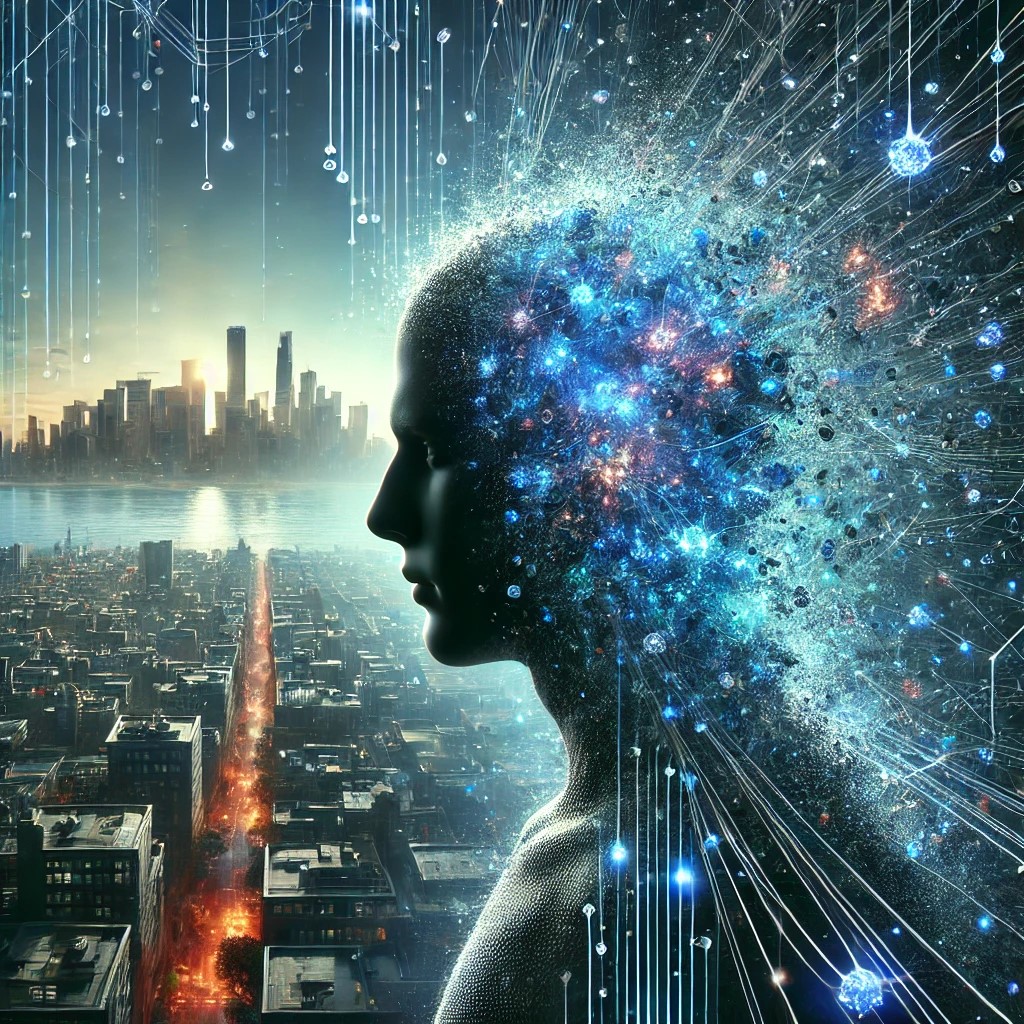
I never thought I’d miss forgetting. But as I sit here, surrounded by the relics of a world that no longer exists, I find myself longing for the blissful ignorance of an imperfect memory.
My name is Dr. Evelyn Reeves, and I’m a neuroscientist. Or at least, I was. These days, titles like that don’t mean much. Not since the Recall.
It started innocently enough. A breakthrough in my lab at the University of Manchester. We were working on a treatment for Alzheimer’s, using a novel approach that combined gene therapy with nanotechnology. The initial results were promising – test subjects showed significant improvements in memory formation and recall.
But we didn’t stop there. Why should we? If we could help those with degenerative brain conditions, why not enhance healthy brains too? The potential was staggering. Imagine never forgetting a face, a fact, a feeling. Imagine perfect recall of every moment of your life.
We called it Mnemosyne, after the Greek goddess of memory. A small injection that would change the world.
And oh, how it changed.
The first human trials were a resounding success. Volunteers reported crystal-clear memories, enhanced cognitive function, even improved emotional regulation. The medical community was abuzz with excitement. This wasn’t just a treatment; it was an evolution of the human mind.
I remember the day we got approval for widespread distribution. The champagne flowed freely in the lab, our laughter echoing off the sterile white walls. We were heroes, pioneers pushing the boundaries of human potential.
If only we’d known.
The rollout was gradual at first. Medical professionals, then academics, then government officials. As word spread of Mnemosyne’s benefits, demand skyrocketed. Soon, it was available to anyone who could afford it.
I took the injection myself, of course. How could I not? I wanted to experience firsthand the miracle we’d created.
The first few weeks were euphoric. Every memory was vivid, every sensation heightened. I could recall entire books I’d read years ago, relive cherished moments with perfect clarity. It was intoxicating.
But then, the cracks began to show.
It started with insomnia. How could we sleep when every moment was so vibrant, so alive? Our brains, supercharged with constant recall, couldn’t shut down. Days blurred into nights as we rode the high of our enhanced cognition.
Then came the sensory overload. Sounds became too loud, lights too bright. The world assaulted our hyper-aware senses constantly. Many retreated indoors, seeking refuge from the overwhelming stimuli.
But the real horror was yet to come.
About six months after the first public doses of Mnemosyne, reports started coming in of strange behavior. People were experiencing vivid flashbacks, reliving traumatic memories as if they were happening in real-time. PTSD rates skyrocketed. Suicides increased dramatically.
And then, the Recall began.
It started slowly. People reported remembering things they’d never experienced. At first, we thought it was a glitch, a crossing of neural pathways. But as the phenomenon spread, a terrifying pattern emerged.
We weren’t just remembering our own lives. We were remembering everyone’s.
The theory, when we finally pieced it together, was devastating. The nanotech in Mnemosyne wasn’t just enhancing our individual memories. It was connecting us, creating a vast neural network across everyone who’d taken the injection. And that network was growing, absorbing the memories of those around us, living or dead.
I remember the day it hit me fully. I was in the grocery store, reaching for a tin of beans, when suddenly I was in a trench in World War I, the smell of gunpowder and death overwhelming me. I blinked, and I was giving birth to a child I’d never had. Another blink, and I was an old man taking his last breath in a hospital bed.
The memories came faster and faster, a torrent of experiences that weren’t mine but felt as real as if they were. I fell to my knees in the middle of the aisle, my mind drowning in the collective consciousness of humanity.
Society began to crumble. How could it not? We’d created a hive mind by accident, and none of us were equipped to handle it. Governments collapsed as leaders lost themselves in the flood of memories. Infrastructure failed as workers became catatonic, lost in visions of lives they’d never lived.
Those who hadn’t taken Mnemosyne watched in horror as their friends and loved ones descended into madness. They tried to help, to find a cure, but it was too late. The nanotech had become self-replicating, spreading through touch, through the air, through our very existence.
In the end, it was those we’d sought to help who saved us. The Alzheimer’s patients, the amnesiacs, those with cognitive impairments – they became immune to the Recall. Their compromized neural pathways rejected the nanotech, leaving them as islands of sanity in a world gone mad.
They formed communities, protected zones where the Mnemosyne-enhanced couldn’t enter. They took in children, raising them without the injection, preserving some semblance of humanity’s future.
As for the rest of us? We wander. Lost in a sea of memories, drifting between moments in history, lives we’ve never lived. Some days are better than others. Some days, I remember who I am, what I’ve done. Those are the hardest days.
I’ve taken to writing everything down, a habit from my old life as a scientist. It helps, sometimes, to anchor me in the present. But even as I write these words, I feel the pull of the Recall, the siren song of a billion lives lived and relived.
There are rumors of a cure. Whispers of a way to undo what we’ve done. I cling to that hope, even as I lose myself in the memories of others who’ve clung to similar hopes throughout history.
But hope is dangerous. Hope makes you remember. And remembering, in this new world, is the most dangerous thing of all.
I think back to that day in the lab, the day we thought we’d changed the world for the better. In a way, I suppose we did. We united humanity in a way never before possible. But at what cost?
As I sit here, pen in hand, I feel another memory coming on. It’s a strong one, insistent. I try to fight it, to stay present, but it’s no use. The world around me fades, replaced by…
…a laboratory. White walls, the smell of disinfectant. It’s familiar, but not mine. I’m looking through someone else’s eyes, someone else’s memory.
I see a team of scientists gathered around a table, excitement palpable in the air. They’re looking at data, results from some kind of trial. I hear voices, snippets of conversation.
“…unprecedented success…”
“…could change everything…”
“…Mnemosyne…”
With a jolt, I realize what I’m seeing. This is the memory of one of my colleagues, from the day we discovered Mnemosyne’s potential. I want to scream, to warn them, but I’m just a passenger in this recollection.
I watch helplessly as they celebrate, as they plan the trials and dream of the accolades to come. I see myself among them, younger, eyes bright with the promise of scientific breakthrough.
If only I could reach through time and stop us. If only I could make us see the catastrophe we were about to unleash.
The memory shifts, and suddenly I’m no longer in the lab. I’m in a hospital room, sterile and cold. A doctor stands over me – no, not me, the person whose memory this is – with a grave expression.
“I’m sorry,” the doctor says, “but the tests confirm it. Early-onset Alzheimer’s.”
The fear and despair I feel aren’t mine, but they might as well be. I know what comes next. The hope Mnemosyne will bring. The decision to be part of the trial. The beginning of the end.
I’m yanked out of the memory as suddenly as I was pulled in, gasping as if I’d been underwater. My hands shake as I pick up my pen again, desperate to record what I’ve seen before it slips away into the endless stream of recollections.
As I write, a thought occurs to me. A dangerous, tantalizing thought. What if the cure isn’t something we need to find, but something we already have? What if the very thing that caused this could also end it?
The irony is almost too much to bear. Alzheimer’s – the disease we sought to conquer – might be our salvation. A controlled degradation of our neural pathways, mimicking the effects of the disease, could potentially disrupt the nanotech network.
It’s a long shot, a desperate gamble. But what do we have to lose? We’re already losing ourselves, day by day, memory by memory.
I stand up, my decision made. I need to find one of the protected communities, share my theory with those still able to act on it. It won’t be easy. The journey will be perilous, filled with others like me, lost in their own mental mazes.
But I have to try. For the sake of those we’ve harmed, for the future we’ve jeopardized, I have to try.
As I gather what few supplies I can, I feel the pull of another memory. But this time, I don’t fight it. I let it wash over me, knowing it might be the last time I experience the full force of the Recall.
I find myself on a beach, waves lapping at my feet. The sun is setting, painting the sky in brilliant oranges and pinks. I can taste the salt in the air, feel the breeze on my skin.
It’s not my memory. I don’t know whose it is. But at this moment, it’s beautiful. Peaceful. A reminder of what we’re fighting for.
As the vision fades and I return to the present, I feel a sense of resolve. We created this problem. Now, it’s up to us to fix it. Even if it means forgetting everything we’ve learned, everything we’ve experienced. Even if it means forgetting who we are.
Because sometimes, forgetting is the only way to truly remember what’s important.
I take one last look around the room, at the scattered papers and remnants of my old life. Then, with a deep breath, I step out into the world. Into a future uncertain and unwritten.
Into hope.
© Sebastian Pearce 2025
 Sebastian Pearce - Flash Fiction and Sports Betting. What can go wrong?
Leave a comment