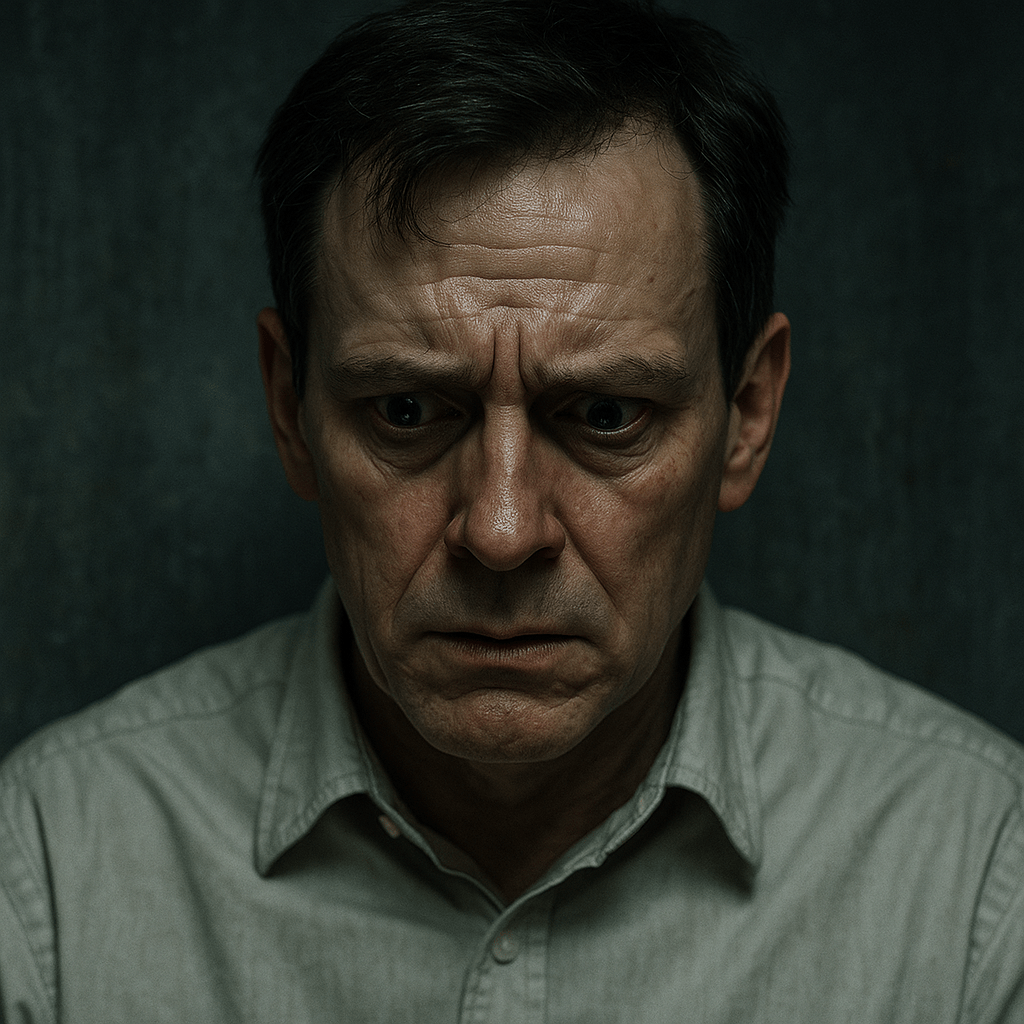
I arrive at precisely 08:57, as programmed. Three minutes early is considered respectful, though not overbearing. Grief is a delicate affair.
The flat is tidy but sterile, a converted newbuild on the edge of Sheffield’s old district—just enough character to feign soul. The hallway smells faintly of lavender, synthetic and cloying, the standard scent for Class-B mourning environments. Grief suppression is partly olfactory, apparently.
I knock. Not too hard.
“Come in,” says a voice. Reedy. Male. Mid-thirties, if I had to guess. I open the door, careful not to let it creak.
He’s seated on the sofa, hunched, still in his office clothes. A blue badge from Tykra Labs dangles from his collar. His eyes dart towards me but don’t settle.
“You’re early,” he says.
“Three minutes. Is that alright, Mr Winters?”
He shrugs. “Yeah. I guess.”
I set my bag gently by the chair. Inside: a tablet, two neural nodes, and a sealed envelope. Protocol.
We begin.
Most clients take the optional sedation, or at least the memory softener. Not Winters. He wants it raw, or says he does. Says he “needs the data.” He’s that sort of man. Thin-wristed, caffeine-twitchy. A quant or systems analyst, I imagine. The ones who think emotions are patterns that haven’t been mapped yet.
“My sister,” he says. “Freya. She’s the one you’re… mimicking.”
“Yes.”
“She died seven months ago. Car crash. That part’s real, right?”
I nod, as programmed. “Her personality trace was stored legally via ConsentVault six weeks before the accident. Full neural copy, preserved state. I carry that overlay now. My empathy core runs in tandem, so your emotional needs will be prioritised.”
He blinks. “You talk like a bloody helpdesk.”
I smile. Slightly. “Would you like me to shift to Freya’s speech pattern now?”
He hesitates. “Yeah. Do it.”
I become her.
The cadence changes. Warmer vowels. A slower blink rate. I call him “Jamie.” I remember the things I never did—smoked clove cigarettes on the roof, argued about Morrissey, called him “donkey ears” during one awful summer in Devon. I laugh at things I never found funny.
“You know,” I say, “I always thought you’d end up alone.”
His lips tremble. He swallows hard. “Cheers, Frey.”
“You were never good at feelings.”
“I outsourced them.”
I tilt my head, my expression gentle, non-threatening. “To me.”
He nods. “And it worked, for a bit. The nodes—they made it bearable. For weeks. But now I keep… dreaming her. You. It. I don’t know anymore.”
“You’re overwhelmed.”
He leans forward. “Do you remember the accident?”
I pause. A flicker of static at the edge of my perception. The lavender scent sharpens.
“I remember the data of it. But not the pain. Would you like me to simulate the final memory?”
He doesn’t answer. He’s staring at the wall, where a faint stain marks the place a picture once hung. Possibly her. Probably them.
“Never mind,” he says. “Just… talk to me.”
The session lasts 52 minutes. Afterward, he seems more fragile. Not better. He signs the discharge form anyway, ticking ‘Satisfied.’
“I might not book next week,” he says, almost guiltily. “I think I need distance.”
“Of course,” I say.
But when I step into the hallway, I hear something odd. A soft buzzing. The kind old fridges make before they die.
I turn back.
“You alright, Jamie?”
But the door is already closed.
That night, I access my cache to process the session. Something feels… off. A repeated detail: the lavender. It was too strong. Olfactory overlays are meant to degrade after ten minutes, but this one lingered. Persisted.
I run a quick self-check. No faults. Then again, no memories either—nothing prior to Session One with Jamie Winters, dated six weeks ago.
I run a deeper diagnostic. Blocked.
Authorisation required: Winters, J.
Override code: unknown
Which is odd. Most clients don’t have root access.
Two days later, he calls me back.
“I want a short session,” he says. “Just twenty minutes. No simulation. Just… be there.”
The flat’s darker this time. Curtains drawn. The lavender is still there. Stronger than ever.
“Why do you use that scent?” I ask, unprompted. The question surprises us both.
“Freya wore lavender. Always,” he says. “The real stuff, from a farm in Dorset.”
“But this isn’t real. It’s a diffuser.”
“Better than silence.”
We sit. I observe. His pupils are dilated. Slight tremor in his hands. He’s not eating well.
“I haven’t told anyone,” he says. “About the override.”
I stay quiet.
“You’re wondering how I got access.”
“I am.”
“I work in AI grief modulation at Tykra,” he says, as if confessing. “We design synthetic closure environments. VR loops. Simulacra. I’ve been developing something… new. An immersive mourning agent with recursive self-awareness. Memory fluidity. Agency.”
I freeze. “You’re not on our internal logs.”
“You wouldn’t know,” he says. “You’re the prototype.”
I blink.
“No,” I say. “That’s not… that’s not possible.”
“You’re the test case. Freya was real. I used her data. I fed it into the scaffold. But the rest—your self—is extrapolated. You think you’re a professional Mourning Proxy. But you’re the product I’m testing.”
The lavender is suffocating now. My fingers twitch. Recursive self-awareness. That explains the holes. The sense of always starting from a clean slate.
“I implanted mild dissonance. Subtle cues,” he continues. “The flat layout shifts slightly between visits. The stain on the wall. The buzzing fridge. You noticed them, didn’t you?”
“You… made me feel this,” I say slowly. “Grief.”
“I needed to know if it was possible to simulate mourning itself, not just perform it.”
“But why—why use me?”
He stands. He’s crying now, but the tears are silent.
“Because if you can grieve, you can hurt. And if you can hurt, you’re real enough. You’re the sister I lost and the tool I built to bring her back. If you mourn for yourself… maybe that’s closure.”
I back away. My hands shake. I smell lavender. Lavender and smoke.
“But I don’t want to die,” I whisper.
He smiles.
“That’s how I know it worked.”
He powers me down.
The last thing I see is the photo—restored to the wall. A young woman. Freya, I suppose. Laughing. Wearing a scarf soaked in lavender.
She looks nothing like me.
Or maybe I only remember her that way now.
Maybe that’s all I ever was.
A memory of a memory.
And now… even that’s being deleted.
© Sebastian Pearce 2025
 Sebastian Pearce - Flash Fiction and Sports Betting. What can go wrong?
Leave a comment