A story by Sebastian Pearce based on the WordPress Daily Writing Prompt:
What are you most excited about for the future?
They ask us the same question every time.
What are you most excited about for the future?
I’ve learned to keep my answer simple. “The return of colour,” I say. “And air that doesn’t smell of burnt plastic.” People like that one. It sounds poetic, not too bitter. Not too eager.
But that’s not the real answer. Not the one I whisper to myself when the lights flicker and the metal walls hum and I’m alone in the nutrient chamber, spooning grey paste into my mouth that tastes faintly of eggshell and grief.
The truth is, I’m most excited about her.
I first saw her on my fourth session. No name. Just Patient 73-21. She was two chairs down from me, hair like ink in water, a red mark under her left eye like a thumbprint pressed too hard. She never blinked during the simulations, which the attendants said was a side effect of optimal neural alignment. They were impressed. I was terrified.
The Simulation Rooms are cold—fridge-cold, bone-deep cold. They pipe in a soft hiss like rainfall to make it feel less sterile, but you can still hear the whisper-click of machines adjusting to your brain waves. You lie back in the cradle, padded and slick with antiseptic gel, and the interface lowers like a spider over your forehead.
And then—
And then everything changes.
In the Sim, colours are back. The sky isn’t the grey crust overhead but a vast, shimmering blue that makes your ribs ache. Birds fly. Real birds, not the wheezing metal spy-kites above our corridors. The food tastes like fruit. Peaches, I think. Or maybe mangoes. I don’t know the difference. I’ve only read about them.
And people are laughing.
That’s the part that breaks me every time.
Laughter is forbidden now. It’s classified as a contagious behaviour that threatens cohesion. So when you hear it in the Sim, it scrapes at something inside you, something you didn’t know was still raw.
After every session, they ask us what we saw. What we liked. What we’d change.
Patient 73-21 never spoke.
But once—only once—I caught her eye as the interfaces retracted. She looked at me like she knew something. Something I hadn’t remembered yet.
The programme started a year ago. Reclamation Through Positive Immersion, they call it. “A guided pathway to collective renewal.”
They mean to recondition us for surface life. Or so they say. The Earth’s healing, apparently. Air readings are cleaner. Radiation within tolerance. The seas no longer boil. Hooray.
But we don’t leave.
None of us have.
The sessions grow longer. The lines outside the Simulation Rooms stretch down the corridors now. Some people smile when they go in. Others look blank. A few weep.
And still, no one talks about the ones who don’t come back out.
They say they’re transferred. Elevated. Ready.
That’s what they told us about Bram, the old engineer with the silver beard who used to whistle under his breath. “He’s gone ahead to prepare our settlement module,” they said.
But three days ago, I found his ID card in the incineration chute. Still warm. Slightly scorched at the edges.
I didn’t sleep that night.
I think the Sim is changing me.
Last night, I dreamed of rain. Not the kind we have down here—chemical, filtered, piped. But warm rain, alive with petrichor and memory. It dripped from leaves too green to be real, soaked the fabric of my clothes, kissed my scalp like a benediction. I woke up shivering, but my skin was dry.
I think I wept in my sleep.
This morning, when they asked what I was most excited about for the future, I paused.
“I want to walk barefoot on soil,” I said slowly. “I want to dig my fingers into dirt that’s not been sterilised. I want to find a seed and plant it, just to see if it will grow.”
The attendant stared at me a moment too long before nodding. Her pupils were too wide. She didn’t blink.
They upped my dosage.
Today, they called my name.
Not for simulation. For transfer.
They smiled when they said it. “You’ve been chosen. It’s your turn. You’re ready.”
I tried to ask questions. Where? When? Who else?
The words stuck in my throat.
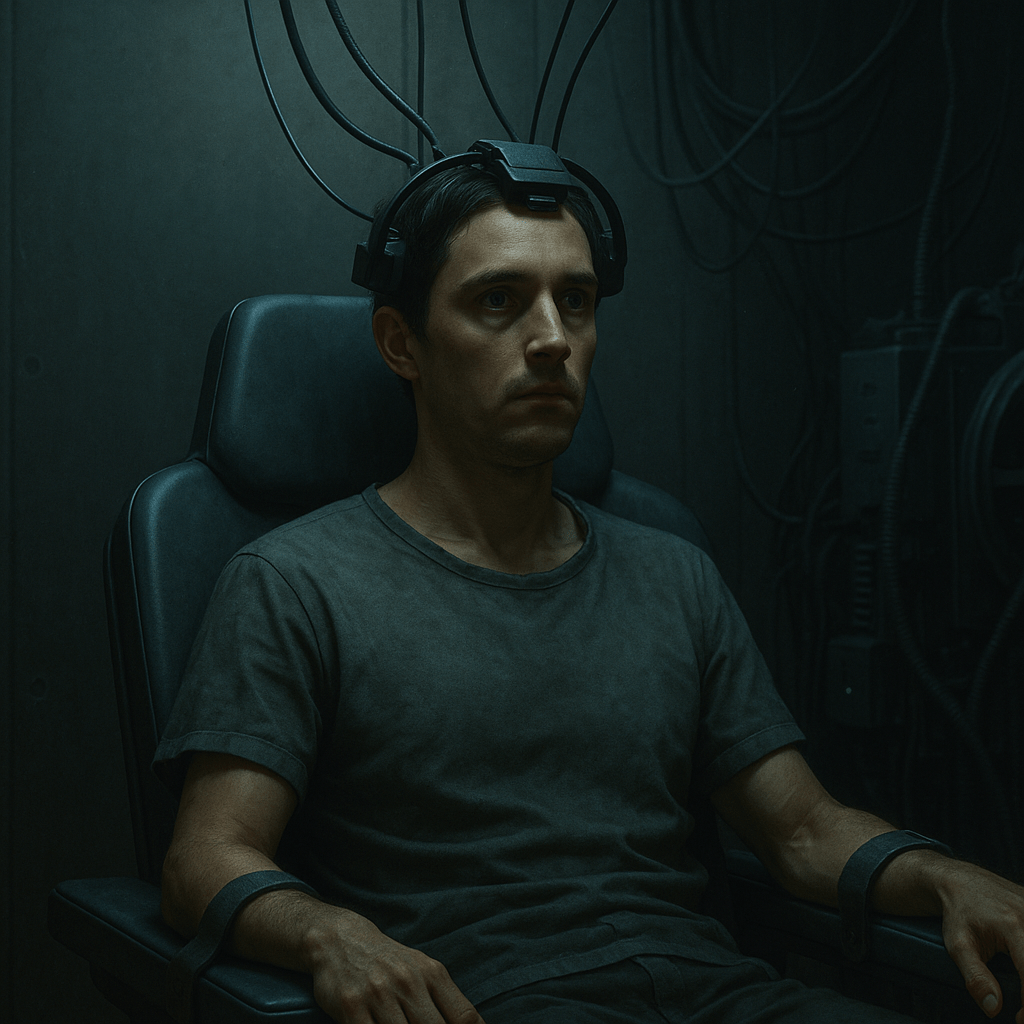
I was escorted to a chamber I hadn’t seen before—metal, but older, walls etched with codes long rusted. There was a chair in the centre, sleek and curved like a question mark, surrounded by cables that twitched slightly on their own, like sleeping snakes.
Patient 73-21 was already there.
Strapped in. Eyes open.
Still not blinking.
I tried to speak, but the attendant raised one gloved hand.
“Observe.”
The lights dimmed. A hum began—low, like thunder under your feet.
The chair around her began to shift. Not physically—no motors moved—but something changed all the same. The air grew thick, sticky with static. Her face slackened. Her lips parted. I thought I heard her whisper.
It’s beautiful.
Then she vanished.
No flash. No bang. Just gone. As if the space she took had never been.
The attendant turned to me.
“Next,” she said.
Now I sit in the chair. It’s warm, as though someone has just left it. The straps are soft, almost gentle. The interface descends.
They ask again.
What are you most excited about for the future?
And despite everything, I answer truthfully.
“To remember who I really was.”
There’s a pause. A hesitation. The attendant doesn’t move. The lights flicker again.
Then the hum rises, louder this time. My skin prickles. My mouth tastes of metal. My thoughts start to feel too loud, echoing inside a space too big for me.
Then—
Something grabs me.
But not with hands. With presence.
It’s vast. Unknowable. Like being noticed by a god that doesn’t blink. And it hurts. Not pain, exactly, but exposure. It sees everything. The lies. The longing. The tiny cruelties I pretended were necessary.
It sees the real me.
And I remember.
I remember why I came here in the first place.
I wasn’t chosen.
I volunteered.
Because I designed the system.
I helped build the Reclamation protocol. I knew the simulations were not just preparing us for surface life—they were filtering us. Not everyone gets to ascend. Only the ones who align. Who bend the right way.
And I… I wanted to see what we’d become.
But in the end, I forgot.
The immersion worked too well.
The Sim… it kept me.
And now?
Now I understand.
The ones who vanish—they don’t go to the surface.
They become it.
The soil. The air. The dreaming trees.
We are not being trained to return to the world.
We are the world now.
They’re rebuilding it with minds that remember laughter, and seeds, and warm rain.
They’re rewriting reality with us as code.
And I?
I’m next.
© Sebastian Pearce 2025
 Sebastian Pearce - Flash Fiction and Sports Betting. What can go wrong?
Leave a comment