A story by Sebastian Pearce based on the WordPress Daily Writing Prompt:


The NeuralSpeak kit arrived in discreet packaging—white box, minimal branding, instructions printed on recycled card that smelled faintly of lavender. Calming, I supposed. Everything about the product was designed to be calming.
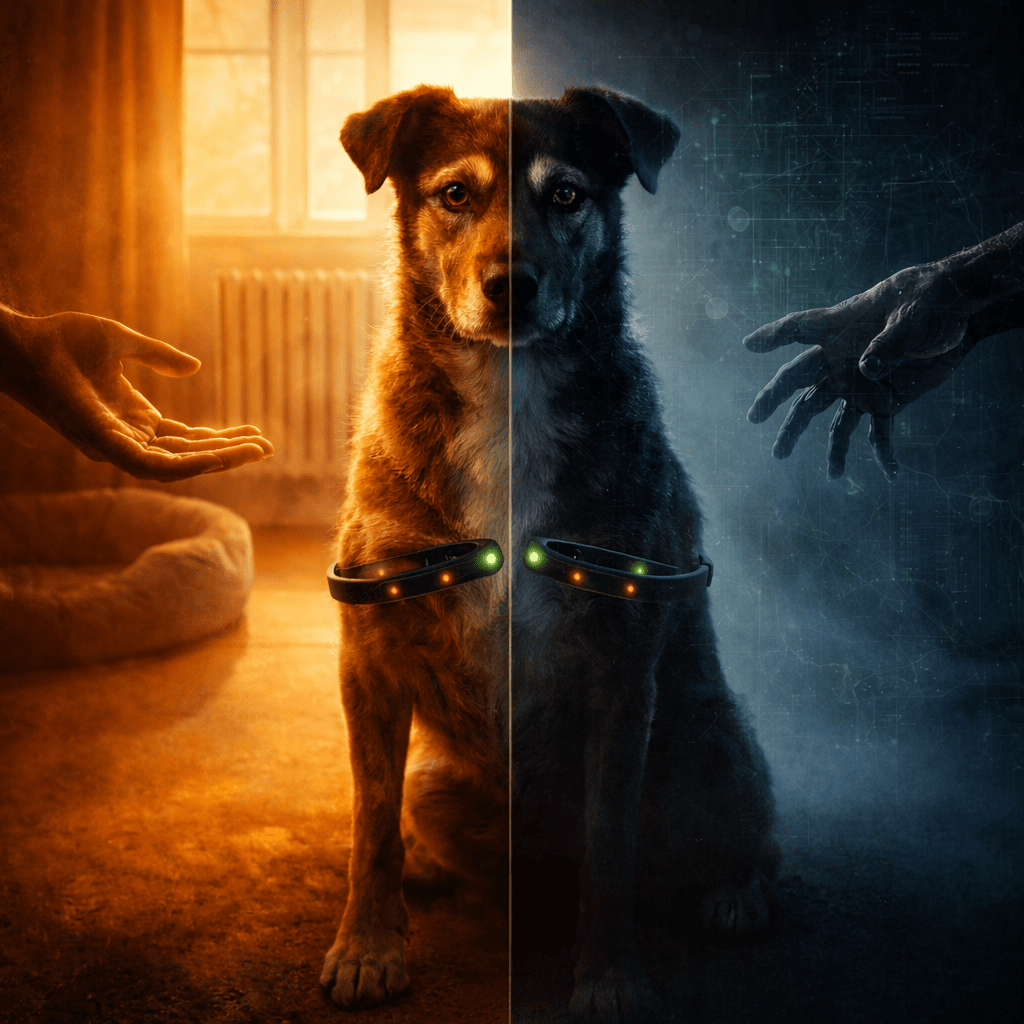
Cooper watched from his bed in the corner, ears flat, as I unpacked the device. He’d been watching me like that for three months now, ever since I’d adopted him from the rescue centre. Always watching, always tense, despite the comfortable flat, the regular meals, the soft bed by the radiator.
“Anxiety from previous trauma,” the behaviourist had said. “Rescue dogs often take time to decompress. He needs to understand he’s safe now.”
But how do you explain safe to a dog? How do you convey home and forever and I promise no one will hurt you again?
NeuralSpeak claimed to solve exactly that problem. One-time neural translation allowing you to communicate a single concept to your pet. The promotional video showed tearful reunions, dogs suddenly understanding why their owners had to leave for work, cats comprehending that the vet visit was for their own good.
“What would you tell them,” the advert asked, “if they could truly understand?”
For Cooper, the answer was simple: You’re safe now. You’re home.
The device looked like a pair of matching headbands—one for human, one scaled for dog. The human band had a small screen and input pad; the animal band had sensors that would “read and translate mammalian emotional and conceptual markers.”
The instructions were surprisingly straightforward. Attach bands. Calibrate for ninety seconds. Form your concept clearly in your mind—not words, but meaning. The device would handle the translation.
Cooper’s ears went back when I approached with his band. He’d never liked things near his head—another trauma response, probably. But he tolerated it, trembling slightly, because he tolerated everything I did with that same tense resignation.
That should have told me something.
The calibration hummed against my temples. On the screen, neural patterns danced—mine in blue, Cooper’s in green. The instructions said both should synchronize, then pulse gold when ready. I watched the patterns spiral closer, merge, separate. Cooper’s green lines were jagged, spiking erratically.
Still anxious, I thought. Soon, boy. Soon you’ll understand.
The display pulsed gold.
I closed my eyes and formed the concept as clearly as I could. Not words—feeling. Safe. Home. Forever. Protected. Loved. The warmth of knowing you’ll never be abandoned again, never be hurt again, never have to be afraid again.
The device grew warm against my skull. There was a sensation like falling forward into water—
—and suddenly I was feeling what Cooper felt.
Terror.
Not abstract anxiety. Not trauma-response nervousness. Pure, immediate, visceral terror. The kind that makes your muscles lock and your bladder weaken and your brain scream RUN.
I gasped, eyes snapping open. Cooper stared at me from across the room. He’d bolted the moment the connection broke, pressed against the far wall, shaking.
“Cooper, it’s okay—”
But the device was still warm. Still active. And in the feedback loop, I’d felt something else beneath the fear: recognition. Not of safety. Of this moment. As if he’d experienced this exact scene before. My voice saying it’s okay. The gentle approach. The promise of safety.
Right before something terrible.
My hands shook as I scrolled through the NeuralSpeak FAQ. Some emotional bleed-through is normal. Your pet may need time to process the new understanding.
But Cooper wasn’t processing understanding. He was processing terror of me.
I thought about the rescue centre, how they’d said his previous owner had “relinquished him voluntarily, no reported abuse.” I’d imagined neglect, maybe. Loneliness. Not… whatever had taught him to fear someone who promised safety.
My phone buzzed. Text from my sister Jenna: How’s the new flatmate? Still settling in?
I stared at the message. Flatmate? I lived alone. Always had.
Another text: Sorry, autocorrect. Meant the dog. How’s Cooper?
Right. Cooper. Of course. My fingers felt numb as I typed back: Fine. Just trying to help him adjust.
But something was wrong. I looked at my calendar. Today was Tuesday. I’d adopted Cooper on… when? I had the paperwork somewhere. Three months ago. Definitely three months. But when I tried to picture bringing him home, the memory was fuzzy, like a photograph taken through fog.
The NeuralSpeak documentation had a warning in small print: Two-way neural feedback may cause temporary disorientation. This is normal and will pass.
I looked at Cooper. He hadn’t moved from the wall, eyes locked on me.
What had he seen in my head during that connection? What concept had he understood?
What had I seen in his?
That night, I found the cameras.
I’d been looking for Cooper’s adoption papers, digging through the desk drawer in my bedroom, when my hand touched something unfamiliar. A small black device, lens pointed at the bed. Another in the living room bookshelf. Three more scattered throughout the flat.
My flat. My cameras. All connected to an app on my phone I didn’t remember installing.
The footage went back six weeks.
I watched myself sleep. Watched myself wake. Watched myself sit at the kitchen table, eating breakfast, staring at nothing. Normal. All normal.
Then I watched myself stand up at 3 AM, eyes open but wrong somehow—empty, mechanical. Watched myself walk to Cooper’s bed. Watched him scramble away as I reached for him, my movements jerky, puppet-like. Watched myself grab him by the scruff, drag him—
I stopped the playback, stomach churning.
The psychiatrist’s card was still in my wallet from the consultation two months ago. The one I’d dismissed as unnecessary after the blackouts “resolved themselves.” I’d been so certain the stress from work was over, that the sleepwalking had stopped.
But Cooper knew better.
The NeuralSpeak device sat on the coffee table, accusatory. I picked it up with shaking hands, scrolled to the data log. There in the feedback analysis: Recipient animal shows pre-existing association between Concept [SAFETY] and Incident Pattern [RECURRING THREAT]. Neural markers suggest repeated exposure to Promise→Danger cycle.
I looked at Cooper. He’d moved to the hallway, positioned where he could watch both me and the front door. Strategic. Escape-route thinking.
How many times had I promised him safety? How many nights had I woken with no memory, while he’d watched me become something else? The cameras showed three incidents in six weeks. But I’d only been recording for six weeks.
How long before that?
The rescue centre’s number was still in my phone. The woman who answered remembered me. “Oh yes, Cooper’s doing well then? We were so glad you wanted to try again after the first two times didn’t work out.”
“Two times?” My voice sounded distant.
“Well, three if we count the initial adoption. But you kept bringing him back within the week, saying it wasn’t a good fit. We thought maybe third time lucky? You seemed so determined to make it work.”
I didn’t remember the first time. Or the second.
I looked at my hand holding the phone. At the small scars on my forearm I’d attributed to Cooper’s nails. At the bruises I’d assumed were from bumping into furniture.
Cooper watched me from the hallway. Still terrified. Still hoping—I could see it now, the desperate hope that maybe this time I’d understand. That maybe this time the person who fed him during the day would remain the person who existed at night.
The concept I’d tried to give him: You’re safe. You’re home.
The concept he’d tried to give me, over and over, in the only way he could: You’re not well. Something’s wrong. We’re both in danger.
And he’d been right all along.
I set down the phone and looked at the NeuralSpeak device. It had one use left—the connection worked both ways. I could send him another message. Something true this time.
I’m sorry. I understand now. I’ll get help.
Or I could tell him what he probably already knew, what he’d been trying to make me understand through three adoptions and countless nights of paralyzed fear:
Run. While you still can.
My finger hovered over the activation button. In the hallway, Cooper tensed, reading my body language the way he’d learned to read everything about me. Waiting to see which version of me would wake up tonight. Whether the promise of help was real, or just another lie in the long pattern of lies his life with me had become.
I looked at my hands and couldn’t remember what I’d done with them in the dark.
But Cooper remembered.
Cooper always remembered.
 Sebastian Pearce - Flash Fiction and Sports Betting. What can go wrong?
Leave a comment